Woke up in pain. Too few painkillers yesterday?
Had breakfast, washed, etc, but then just couldn't do anything. Lay down on sofa for a few hours.
Reheated some old food for lunch, got a cab and went to the clinic.
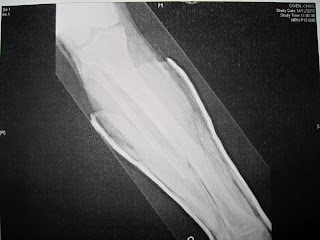
The xrays show that the leg is very well aligned when viewed from the side, but not so good from the front. So Mr Lohoti has calculated a new batch of adjustments which will pull the joint apart and stretch the leg. I guess that once the alignment improves he will then reduce the gap again.
Still in pain for the rest of the day.
1. The skin feels like it has an infinitely severe nettle sting.
2. The bone aches like there is a vice on my leg.
3. The occasional shooting pain zaps through the shin like a stabbing knife.
It saps the will to do anything.
Wednesday, January 12, 2011

Monday, January 10, 2011
10 January 2011

The end of the 4th week!
 The whole leg goes a red-blue sort of colour when I first get up and move around in the mornings. (The picture was taken sometime after I got up, and so doesn't show the massive difference between the two). From thigh downwards the leg is much darker than the healthy leg. It's still painful when I lower it down, but not so bad as previously.
I don't think the infection is completely gone yet.
I have a slight tingling sensation in my right hand, near the finger tips. Must talk to physio/doctor about it, but is suspect it is caused by the crutches. (After-note; probably pressure on the nerve, it happens whenever I use the crutches.)
Physio appointment at 3pm.
Exercises going reasonably well. Must focus on adding the extra moves, and on imposing a more disciplined routine.
Sunday, January 9, 2011
9 January 2011
The purple bruise on the base of my heel and foot is now gone. After the accident, I had a purple-maroon bruise covering the whole of the rear half of my right thigh. The muscle and flesh were hard and stiff to the touch. And painful too. I realised that the bruise had largely disappeared about a few days ago.
I still have an occasional shooting pain in the shin where the 3rd pin and wire enter the leg.

I still have an occasional shooting pain in the shin where the 3rd pin and wire enter the leg.
Took a taxi to St John's Hill and had lunch with Beach and two of his dancing friends, Julia and Claire. They were going dancing after lunch, which made me a bit envious.
Beach and I went to see Tron. We were late, but we didn't miss much. In fact, the film is not really worth the effort. Don't bother.
Beach kindly drove me home afterwards.
Beach kindly drove me home afterwards.
Saturday, January 8, 2011
8 January 2011
 I took a long hobble into Balham, only resting once on the way. (I now know every place to sit on the way.) I've still only got the borrowed shorts to wear, so the metalwork gets really cold (the temperature is just above freezing) and extracts the heat from my leg. It's a bone numbing pain.
 I noticed a couple of girls from yoga in Starbucks, so I swerved inside to say hello. ...Managed to make them squirm at the sight of my kebabish leg.
One of them is an instructor. She tells me that some disabled people do yoga on chairs, so now my determination to restart classes is doubled! I'm going to speak to the doctors and physios this week and get the all-clear.
One of them is an instructor. She tells me that some disabled people do yoga on chairs, so now my determination to restart classes is doubled! I'm going to speak to the doctors and physios this week and get the all-clear.
 I have lunch in "the poncy place" (Harrisons) where there are low seats and footstools. Then I hobbled down to the seamstress to collect my jeans. I fit the sleeve she's made, tighten the ribbons around the frame, and the leg feels warmer already! Great. Jeans and sleeve £28 all in.
Hobble back home, resting twice. Try on the jeans... they just squeeze over the frame if I pull hard. No more cold knees for me! A good day at last.
Friday, January 7, 2011
The Taylor Spatial Frame
 What a gadget! This scaffolding enclosing my leg (otherwise known as an external fixator) is worth as much a small car. ...But don't get any ideas about undoing it and leaving my leg dangling in the breeze! They are only used once, with the exception of those that are "scrapped" and sent to India.
If anyone says "I've never seen one of those before!" then you can now educate them:
The modern method was adapted by Professor Gavril Abramovich Ilizarov in the 1950s after having to treat orthopedic conditions in the Kurgan region of Siberia, but like most new ideas the first use seems to have appeared in ancient Greece!
http://en.wikipedia.org/wiki/External_fixationIt is based on the same mechanical concept as a flight simulator used to train pilots. Flight Sim's need to be able to swing around in all directions so that the poor air-sick trainee gets used to hitting the brown paper bag in motion. The 6 angled struts can change length according to a fixed algorithm, and so can change the position of one ring with respect to the other through all dimensions (except the 4th). In aerodynamic terms (isn't aero-dy-manic a much better word?) the rings can rotate, pitch or yaw. And that means that the fixed bone can be repositioned as required.
 In the flight sim, the struts are hydraulic rams, in the limb reconstruction device, they are simple screws.
The repositioning is done slowly, 1-2 mm per day, to avoid damage to s
oft tissue and more importantly, the nerves. The consultant displays the Xray pictures on a PC and draws various lines to work out where the bones should be as compared
to where they are. Th
e programme then calculates the adjustments needed to correctly align the busted limb. The wearer makes the adjustments every day, preferably in the morning due t
o the period of pain that will follow (not easy to sleep after making the adjustments!). Sometimes the whole strut has to be changed to fit a longer or smaller one. That's done with an extra strut
added to temporarily brace the frame.

The problem... The markings are quite fine, and the device is on a leg quite
a long way away from the owners eyes. It's difficult to see the readings!
So the solution is a camera. I tried a web cam, which required too many hands and a quantum leap in spatial awareness and remote control. Try patting your head whilst rubbing your stomach whilst checking your performance in a double mirror... You get the idea. The best solution was the camera on my mobile phone. It auto-focuses, adapts for lig
hting conditions and is easily controlled.

So, take a photo to check current settings, then adjust, check with anoth
er photo. Mostly I get it right in 3 attempts.
But I've learned to take painkillers about 1 hour before making the adjustments. :-(

Saturday, January 1, 2011
Tips for a new life in a new year
This is life Jim, but not as I knew it.

There is a great list of collected tips and advice for anyone with broken bones:- http://www.mybrokenleg.com/tips.html

Friday, December 24, 2010
Some Early Lessons At Christmas
Christmas was spent at "home". That is, at my mother's house.
Following a flip-flop series of discussions on how to get there, I opted for the train, and found out some realities the hard way.
 Firstly, travel by minicab can be painful. MPVs tend to have suspension designed for 6-8 people, so when the car has only two people the ride can be "firm". Given the state of London roads at present (snow damage and low council budgets...) it's a bumpy ride, and I felt every bump. I also discovered that acceleration and braking is just as bad as bumping. I resorted to holding the leg in the air by grabbing the frame and lifting. It's probably a good biceps workout.
[I have since come to the conclusion that about 80% of minicab drivers need driving lessons. But more of that later.]
Secondly, be ready for unexpected issue when you use "mobility assistance" at railway stations. On the face of it, the offer of an electric buggy to transport you to the train is wonderful, and so it is! The driver even managed to manoeuvre the buggy to with easy reach of the ticket machine. However...
On arrival at Paddington you are advised to go to the yellow telephone on the wall at the cab rank, and press the button. I pressed the button and waited, and waited, and waited. The line eventually went dead. After several button-presses and several long waits, a lady answered and, since I had pre-booked, she knew who I was and what I needed. She told me that a buggy would come very soon.
 Note that there are no seats / chairs / benches anywhere near the mobility assistance telephone. I was standing on one leg, and, given the freezing cold weather of December 2010, I'm getting colder by the minute. I've still only got the torn shorts that Debbie gave me at the hospital. With the pain, the cold, and no sign of help, I was in a state of near-panic.
After a further 10 minutes a member of the station staff passed by. I called to him and pleaded for assistance. He radioed someone, and after about 2-3 more minutes the buggy turned up. Now, try climbing into one of those buggies with a frame on your leg, and supporting most of your weight on crutches. (Rumour has it that when the British Army bought the Clansman radio system back in the Eighties, the Trial team received the first radio sets and backpacks for testing. They immediately invited the designers to help with the trials. They gave each of the designers a pair of army boots, a rifle, a tin hat, and a radio mounted in the back pack. They then took them on a relatively short walk around Blandford camp. It didn't take long before the designers received appropriate enlightenment, took the radios back, and completely redesigned the back packs.) Whoever buys these buggies should get some invalids to take part in the selection process.
 Once you are on-board, the buggy is great. At least the mobility assistance service gets you onto the train as soon as it is available, in advance of other passenger being allowed on. Just one little problem... I pity the drivers! Are you one of those people who wander down the platform, dragging your wheelie bag and nattering to your fellow traveller, utterly oblivious to the sound of beep beep beep behind you? We must have been inches behind some of these people who just didn't know we were there despite the continuous use of the buggy's horn. ...To be fair, it's a pathetic little horn. These buggies are surprisingly busy, and any delay means that someone is waiting, probably in the cold, and standing on on leg. So please make way!
They kindly put a ramp down form me to hobble onto the train. That's good. Very good. Also very good was the similar treatment at the sleepy rural station where I disembarked.
And now to lesson three. I shuffled into my reserved seat. I'd booked a table seat so that my leg would have plenty of room. A few minutes later an attractive blond lady sat down opposite me. I said "Excuse me. Would you mind sitting in that seat?" I indicated the seat diagonally opposite across the table. She looked at me as if I had asked her for £50, or perhaps to take another train. I said "Look under the table." She did, and instantly turned powder white, said "Oh my god!" and quickly moved to the next seat. The majority of people are horrified by the site of a leg with spikes in it. Leave it exposed and people give you a wide berth, but if you cover it up, they are far less helpful and will even bump into to you despite your crutches.
 Lesson 4. If you tell the reservations people that you have a broken leg, they kindly book you a seat at the end of the carriage so that you don't have to walk half way down it. Now, train carriages rotate around the centre of the carriage. The ends are effectly on the end of a long lever, they move the most, swinging and bumping at every opportunity. And rails are not a smooth as you think. If you have a broken leg, and the bits are rubbing together with every movement, and the swelling is painful every time the leg is bumped, sitting at the end of the carriage is not a good idea. By the time we arrived I was in extremis. For the return trip I booked a seat in the middle of the carriage, despite the protests of the kindly booking agent.
 Finally, number 5. Travellers, and by extension, most of the people in London, fall into two widely separate groups with very little in between; the considerate people who offer to help and are apologetic towards invalids, and the totally inconsiderate people who just don't know you are there or who manage to blank out your existence. If I have ever been a member of the latter group then I apologise! I hope to always fall into the former group given my recent experiences.
And so to Christmas...
Unfortunately my father died of prostate cancer in September and my mother has had a hard time getting over it, but she's getting there slowly. As she puts it, forty years being totally dependent on someone leaves you unable to do very much yourself. Which meant that one invalid and one shell-shocked OAP needed quite a lot of help.
Thankfully my sister and her husband looked after us throughout the Christmas period. They bought and cooked all the food, and fetched and carried.
My most grateful thanks to them.
Following a flip-flop series of discussions on how to get there, I opted for the train, and found out some realities the hard way.

[I have since come to the conclusion that about 80% of minicab drivers need driving lessons. But more of that later.]
Secondly, be ready for unexpected issue when you use "mobility assistance" at railway stations. On the face of it, the offer of an electric buggy to transport you to the train is wonderful, and so it is! The driver even managed to manoeuvre the buggy to with easy reach of the ticket machine. However...
On arrival at Paddington you are advised to go to the yellow telephone on the wall at the cab rank, and press the button. I pressed the button and waited, and waited, and waited. The line eventually went dead. After several button-presses and several long waits, a lady answered and, since I had pre-booked, she knew who I was and what I needed. She told me that a buggy would come very soon.

After a further 10 minutes a member of the station staff passed by. I called to him and pleaded for assistance. He radioed someone, and after about 2-3 more minutes the buggy turned up. Now, try climbing into one of those buggies with a frame on your leg, and supporting most of your weight on crutches. (Rumour has it that when the British Army bought the Clansman radio system back in the Eighties, the Trial team received the first radio sets and backpacks for testing. They immediately invited the designers to help with the trials. They gave each of the designers a pair of army boots, a rifle, a tin hat, and a radio mounted in the back pack. They then took them on a relatively short walk around Blandford camp. It didn't take long before the designers received appropriate enlightenment, took the radios back, and completely redesigned the back packs.) Whoever buys these buggies should get some invalids to take part in the selection process.

They kindly put a ramp down form me to hobble onto the train. That's good. Very good. Also very good was the similar treatment at the sleepy rural station where I disembarked.
And now to lesson three. I shuffled into my reserved seat. I'd booked a table seat so that my leg would have plenty of room. A few minutes later an attractive blond lady sat down opposite me. I said "Excuse me. Would you mind sitting in that seat?" I indicated the seat diagonally opposite across the table. She looked at me as if I had asked her for £50, or perhaps to take another train. I said "Look under the table." She did, and instantly turned powder white, said "Oh my god!" and quickly moved to the next seat. The majority of people are horrified by the site of a leg with spikes in it. Leave it exposed and people give you a wide berth, but if you cover it up, they are far less helpful and will even bump into to you despite your crutches.


And so to Christmas...
Unfortunately my father died of prostate cancer in September and my mother has had a hard time getting over it, but she's getting there slowly. As she puts it, forty years being totally dependent on someone leaves you unable to do very much yourself. Which meant that one invalid and one shell-shocked OAP needed quite a lot of help.
Thankfully my sister and her husband looked after us throughout the Christmas period. They bought and cooked all the food, and fetched and carried.
My most grateful thanks to them.
Monday, December 20, 2010
The Smallest Room
I woke up on Saturday morning with a strange realisation... I had slept. Ah.. the benefits of a private ward!
Fair enough, it was still so early that the morning shift nurse had not yet arrived, but the relief was a godsend.
I'd gone to sleep despite the dull mechanical roar of air con units outside. The window was open and I'd been too confused and tired to work out that closing the window might reduce the noise level. I feared having to put up with the background nuisance for several days.
 It was snowing outside. Turning on the TV I discovered that I had missed the last four days. The Arctic had arrived in southern England., and the world was coming to a halt whilst I'd been elsewhere. Nevertheless the window was too high for me to close, and only the fact that the heating system was burning money was keeping me warm.
Then the heating broke down.
All my clothes were shredded, having been cut off me in A&E. The nurse checks for pyjamas but can't find any. I was getting cold.
I use the alert button to call for help. This is a MAJOR improvement; a 5 second response time (compared with 35 minutes in the public ward)! On several occasions I hear alerts from other patients and immediately hear the footsteps of someone moving quickly down the corridor. I also hear the same quick response to monitor alarms.
I asked the nurse if we could close the window... It was way above her limited reach and she wasn't prepared to climb onto a chair. She produced a small electric heater which was to save my bacon over the next couple of days. Other people in the private ward were not so lucky. Eventually I precariously tottered below the open window and managed to close it by using my crutch as a lever. This amused me by baffling the nurse. She couldn't work it out.
I stayed in the Guthrie Ward for 3 days. Saturday and Sunday were phenomenally boring. The snowy view from the window includes the corridor into several of the operating theatres (and so I see faceless blue-green clad people walking up and down) and down onto another ward which I initially mistake for some sort of factory floor. There were no staff other than the basic weekend duty team. ...Something like being in limbo. Imagine day-time TV programmes in the run-up to Christmas; just how many ancient repeats is it possible to show? Guns of Navarone, Navarone the Sequel, Navarone part III, Navarone Returns.... zzzz.
 A nurse came to remove the catheter, a highly desirable event which he assures me will not be painful. Donning rubber gloves, he uses a syringe to extract the water from the internal balloon and then without warning pulls the tube out. I scream as I feel my guts being extracted from the inside. For the next three days it will be painful to take a pee. I became extremely worried about the possibility of having to have another catheter fitted, so I pee at every possible opportunity. When the nurse returns later that day he glances at the two urinal bottles by the side of the bed and says that we might need to refit the catheter. (Oh no!) I point out that the bottles are both full. A trick of the light has made him think that they were empty, but he still managed to scare me witless.
The room has an "en-suite" toilet. Well, more accurately it's a broom cupboard with a toilet in it, but they don't seem to have any brooms. It's so small that I have problems getting in through the door with my frame on my leg. I have to get the crutches inside first, then hop carefully around the edge of the door to get my left leg in, and then manoeuvre the frame through the gap.
The ward room is filled with furniture. Given that I have;-
(a) a bed
(b) a toilet
(c) only one visitor
(d) no drinks,
...it seems odd to provide;
(a) 3 chairs
(b) a commode
(c) a small fridge.
There is also a wardrobe and drawer units which could possibly hold my clothes if they were not shredded and in plastic bags.
Maz paid me a visit on Sunday. It's nice to talk to someone, and I realise that I'm losing the ability to communicate. She was perhaps suffering from the previous nights party, and probably would have preferred to stay at home if she hadn't already said she would visit on Sunday, and so gratefully welcomes the opportunity to help me with consuming my lunch. (The food is much better here in Guthrie, but the menu is the same for lunch and for dinner.) Maz brought me oranges, shaving foam, and a book. I used the hospital-issue razor with shower gel that morning, and resemble someone who dived face first through a thorn bush.
By Monday I am planning my escape. If I can't knot my sheets together, maybe I can tunnel out through the loose floorboard in the tiny toilet. Everybody who comes in (there is a stream of nurses, doctors, physios, etc) has to hear my plea to let me go. I'm shown how to go up and down stairs with crutches (quite scary the first time you try it). I demonstrate how well I can move my leg and how conscientiously I'm doing my exercises.
 Eventually I am told that I will be allowed to go once Debbie (the limb reconstruction specialist) has redressed the pin sites. I call Natalie and ask if she will pick me up. Debbie must be the busiest person in the hospital. Most of the staff I see are wandering around, having a chat, ambling from one adequately performed task to the next. Debbie rushes from place to place, talks quickly and succinctly, and clearly has a lot to do because she always ( errr.. twice) arrives much later than I'm led to expect. In just a few minutes she shows me how to dress the pin sites, hands over a large plastic bag of wound dressing kits, swabs and sterile water sachets, and gives me a bag of split-seamed shorts left behind by previous patients.
Luckily Natalie has been to Pete's house and collected a T shirt, sweat shirt etc.
A porter is called to wheel me out to the exit, Natalie pulls up in her car, and I suddenly realise how frightening it is to be weak with an injury, and attempting to negotiate icy pavements on crutches.
A short but painful ride home is followed by a proper curry. It's great to be home!
Fair enough, it was still so early that the morning shift nurse had not yet arrived, but the relief was a godsend.
I'd gone to sleep despite the dull mechanical roar of air con units outside. The window was open and I'd been too confused and tired to work out that closing the window might reduce the noise level. I feared having to put up with the background nuisance for several days.

Then the heating broke down.
All my clothes were shredded, having been cut off me in A&E. The nurse checks for pyjamas but can't find any. I was getting cold.
I use the alert button to call for help. This is a MAJOR improvement; a 5 second response time (compared with 35 minutes in the public ward)! On several occasions I hear alerts from other patients and immediately hear the footsteps of someone moving quickly down the corridor. I also hear the same quick response to monitor alarms.
I asked the nurse if we could close the window... It was way above her limited reach and she wasn't prepared to climb onto a chair. She produced a small electric heater which was to save my bacon over the next couple of days. Other people in the private ward were not so lucky. Eventually I precariously tottered below the open window and managed to close it by using my crutch as a lever. This amused me by baffling the nurse. She couldn't work it out.
I stayed in the Guthrie Ward for 3 days. Saturday and Sunday were phenomenally boring. The snowy view from the window includes the corridor into several of the operating theatres (and so I see faceless blue-green clad people walking up and down) and down onto another ward which I initially mistake for some sort of factory floor. There were no staff other than the basic weekend duty team. ...Something like being in limbo. Imagine day-time TV programmes in the run-up to Christmas; just how many ancient repeats is it possible to show? Guns of Navarone, Navarone the Sequel, Navarone part III, Navarone Returns.... zzzz.

The room has an "en-suite" toilet. Well, more accurately it's a broom cupboard with a toilet in it, but they don't seem to have any brooms. It's so small that I have problems getting in through the door with my frame on my leg. I have to get the crutches inside first, then hop carefully around the edge of the door to get my left leg in, and then manoeuvre the frame through the gap.
The ward room is filled with furniture. Given that I have;-
(a) a bed
(b) a toilet
(c) only one visitor
(d) no drinks,
...it seems odd to provide;
(a) 3 chairs
(b) a commode
(c) a small fridge.
There is also a wardrobe and drawer units which could possibly hold my clothes if they were not shredded and in plastic bags.
Maz paid me a visit on Sunday. It's nice to talk to someone, and I realise that I'm losing the ability to communicate. She was perhaps suffering from the previous nights party, and probably would have preferred to stay at home if she hadn't already said she would visit on Sunday, and so gratefully welcomes the opportunity to help me with consuming my lunch. (The food is much better here in Guthrie, but the menu is the same for lunch and for dinner.) Maz brought me oranges, shaving foam, and a book. I used the hospital-issue razor with shower gel that morning, and resemble someone who dived face first through a thorn bush.
By Monday I am planning my escape. If I can't knot my sheets together, maybe I can tunnel out through the loose floorboard in the tiny toilet. Everybody who comes in (there is a stream of nurses, doctors, physios, etc) has to hear my plea to let me go. I'm shown how to go up and down stairs with crutches (quite scary the first time you try it). I demonstrate how well I can move my leg and how conscientiously I'm doing my exercises.

Luckily Natalie has been to Pete's house and collected a T shirt, sweat shirt etc.
A porter is called to wheel me out to the exit, Natalie pulls up in her car, and I suddenly realise how frightening it is to be weak with an injury, and attempting to negotiate icy pavements on crutches.
A short but painful ride home is followed by a proper curry. It's great to be home!
Saturday, December 18, 2010
Catheter
By Friday lunchtime I've got a severe pain in my bladder and I can hardly take a pee. All I can do is lie on my back, wince with each stabbing pain, and groan. A nurse comes by and I tell that I think I may have a bladder infection. They fetch a doctor. He prods, pokes and taps at my abdomen. A light tap is enough to make me shout in pain. A small group of doctors and nurses discuss what is to be done, there are veiled suggestions of checking the prostate, but the conclusion is drawn; no infection.
The blue curtain is whipped into place and minutes later I've got my bits sticking out of a hole in a large sheet of waterproof paper. The doctor applies some lube, and pushes a plastic tube inside me. I can't say it was gentle, though it probably was. It's supposed to be painless... On the second attempt I was "arrrrrrghing" at the top of my voice and eventually the tube entered my bladder. He had not yet connected the bag and so urine starts to pour everywhere. The nurse rapidly connects me up and then all eyes are on the calibrations on the catheter bag to see how much comes out.

It's a Foley catheter which has a small balloon inside the bladder to stop the tube falling out, or in my case, to stop the patient extracting it! Catheters are scaled according to "the French Gauge". The French gauge was devised by Joseph-Frédéric-Benoît Charrière, a 19th-century Parisian maker of surgical instruments, who defined the "diameter times 3" relationship.
The catheter is now my constant companion. I can feel it every time I bend at the waist. It's the strangest thing; not being able to stop yourself peeing. You can feel it draining out drip by dribble, non-stop. All day, all night. Periodically, the nurse measures the contents of the bag, and sometimes she empties it.
The blue curtain is whipped into place and minutes later I've got my bits sticking out of a hole in a large sheet of waterproof paper. The doctor applies some lube, and pushes a plastic tube inside me. I can't say it was gentle, though it probably was. It's supposed to be painless... On the second attempt I was "arrrrrrghing" at the top of my voice and eventually the tube entered my bladder. He had not yet connected the bag and so urine starts to pour everywhere. The nurse rapidly connects me up and then all eyes are on the calibrations on the catheter bag to see how much comes out.

It's a Foley catheter which has a small balloon inside the bladder to stop the tube falling out, or in my case, to stop the patient extracting it! Catheters are scaled according to "the French Gauge". The French gauge was devised by Joseph-Frédéric-Benoît Charrière, a 19th-century Parisian maker of surgical instruments, who defined the "diameter times 3" relationship.
The catheter is now my constant companion. I can feel it every time I bend at the waist. It's the strangest thing; not being able to stop yourself peeing. You can feel it draining out drip by dribble, non-stop. All day, all night. Periodically, the nurse measures the contents of the bag, and sometimes she empties it.
The Ward - H Bosch was 'ere
When I come to some sort of sensibility on Friday morning I find that I'm sharing a ward with 3 others.
 There's an old Irish guy who knows everything. He tells the consultant what he should be doing. He tells the nurses how to do their jobs. He phones people and tells them how the nurses and doctors don't know what they are doing. He mutters to himself, probably to argue that he knows better than himself. He says one thing to one person and two minutes later he says something else to another. Total bullshitter, the whole time, non-stop. There's no peace. If I could move I'd go and shut him up.
There's a young father who wanders about carrying his catheter bag. It's full of a mixture of urine and blood, splashing about in a frothy mix for all to see. He speaks an East European language. His wife and small child come to visit. The child plays on the ward floor whilst her parents cuddle and my monitor alarms go off and the pain or drugs move my mind to strange places.
There's a guy, maybe late 40's, who has a fractured skull. He fell over and banged his head, but he doesn't know where or how. There's blood from his ears, but it's apparently a minor injury and they will send him home. He doesn't have any family. His mother died a few year
The food is so bad that I can't eat it. Dry, over cooked, tasteless, and not enough to drink. There's no attempt to substitute for milk. A diet like this will have me losing pounds! (After-thought: Why did nobody talk to me about nutrition for bone growth?)
 They move the Irish bullshitter out of the ward. Not much later they wheel in a guy whose
Pete appears at the door. At last a friendly face. He brought me ginger beer, jaffa cakes, and other sweet eats. It's nice to hold a relatively normal conversation, but I'm wired, a very strange over-alert state of fight or flight. It's a state of near panic. I really want to get out of the ward as quickly as possible. The nurses seem annoyed when I ask if Pete could have a cup of tea. I realise that apart from mealtimes, and my small plastic glass of orange just, I'm not drinking anything. The p
A couple of hours later I am told that my request to move to a private ward has been granted. A nurse helps me move to a chair with wheels. She piles my bike gear, smashed helmet, and other chopped-up belongings in plastic bags on top of me, I feel like a bag lady. Then she wheels me off to another part of the hospital, (jeez the corridors are cold) and into a tiny single room that's full of furniture. But at last I have peace and quiet.
I tell the nurse that I don't want anythig and that I'm going to sleep. She tells me that I have to wait until I have had my obs done, and she's given me my drugs for the night.

There's an old Irish guy who knows everything. He tells the consultant what he should be doing. He tells the nurses how to do their jobs. He phones people and tells them how the nurses and doctors don't know what they are doing. He mutters to himself, probably to argue that he knows better than himself. He says one thing to one person and two minutes later he says something else to another. Total bullshitter, the whole time, non-stop. There's no peace. If I could move I'd go and shut him up.There's a young father who wanders about carrying his catheter bag. It's full of a mixture of urine and blood, splashing about in a frothy mix for all to see. He speaks an East European language. His wife and small child come to visit. The child plays on the ward floor whilst her parents cuddle and my monitor alarms go off and the pain or drugs move my mind to strange places.
There's a guy, maybe late 40's, who has a fractured skull. He fell over and banged his head, but he doesn't know where or how. There's blood from his ears, but it's apparently a minor injury and they will send him home. He doesn't have any family. His mother died a few year
s ago. He lived with his mother all his life. He has a friend who might help. He has a speech impediment and maybe he's not the sharpest stick in the box. He's a floor polisher who used to work at a nearby hospital, but he lost his job. He stares, mainly at me. He stares whilst the nurses do things for me. I'm trying to take a pee in a bottle, and he stares. He stares while I'm in pain and about to get a catheter installed. He freaks me out. Shudders go up my spine.
The food is so bad that I can't eat it. Dry, over cooked, tasteless, and not enough to drink. There's no attempt to substitute for milk. A diet like this will have me losing pounds! (After-thought: Why did nobody talk to me about nutrition for bone growth?)
They move the Irish bullshitter out of the ward. Not much later they wheel in a guy whosebed is festooned with monitors, oxygen bottles, etc. He has a mask on, covering the site of the surgery, presumably a broken jaw, but he seems to be able to speak. The gas hisses and monitors beep. Maybe I looked like that the previous evening. Later some friends come to visit him. It's like a party. Joking, laughing, eating and drinking.
Pete appears at the door. At last a friendly face. He brought me ginger beer, jaffa cakes, and other sweet eats. It's nice to hold a relatively normal conversation, but I'm wired, a very strange over-alert state of fight or flight. It's a state of near panic. I really want to get out of the ward as quickly as possible. The nurses seem annoyed when I ask if Pete could have a cup of tea. I realise that apart from mealtimes, and my small plastic glass of orange just, I'm not drinking anything. The p
leasure of a cup has been absent for quite some time. I've been living on a drip.
Pete leaves.
The new patient needs to use the toilet so the nurse gives him a bed pan. He misses it, and then tries to clean up the mess ith his hands but just makes it worse. The nurses are angry, the ward stinks like... I don't know, but it stinks and nobody opens a window. I feel very ill.
A couple of hours later I am told that my request to move to a private ward has been granted. A nurse helps me move to a chair with wheels. She piles my bike gear, smashed helmet, and other chopped-up belongings in plastic bags on top of me, I feel like a bag lady. Then she wheels me off to another part of the hospital, (jeez the corridors are cold) and into a tiny single room that's full of furniture. But at last I have peace and quiet.
I tell the nurse that I don't want anythig and that I'm going to sleep. She tells me that I have to wait until I have had my obs done, and she's given me my drugs for the night.
She comes back a couple of hours later. I refuse the Tramadol because it gives me wierd spooky dreams. Imagine Hieronymous Bosch creatures and scenery on a sort of board game filled with little boxes each containing Bosch's monsters and moving around like
some 2-dimensional Rubik Cube.
I refuse another painkiller because it's an anti-inflammatory and shouldn't be used for bone fractures (according to the therapist). The nurse argues with me because she has got her instructions and the doctor knows best. I tell her to speak to the doctor and consultant and the therapist. Next day the drug regime has changed.
That night I sleep well. The catheter means that I can't roll over, but I do so in my sleep and the bed gets wet.
Friday, December 17, 2010
After the Op
I wake up in hell.
 I'm decide I am going to stay awake. I don't trust the nurses. There's a night nurse sitting at the end of the room.

It's light, I've survived the night. But now a new level of hell is revealed.
When I say "wake" I mean that I have become vaguely aware. It's dark. There are quite a few people standing around talking.
Beep beep beep beep beep beep beep beep...
I seem to talk to anyone who talks to me. When we talk the beeping stops. When they stop talking, I go away, the beeping comes back. It's not that the world goes away, instead I go down, falling into nothing. Again they talk, I know they are there. They stop, and again I go away, falling, sinking, stopping.
Beep beep beep beep beep beep beep beep....
There's a discussion.
"When we talk he's here, but then he goes..."
"Better do blah blah." "Blah blah". "Blah"
Going, gone. Stopping, stop.
I can feel my arm move, they're fiddling with something.
Beep beep beep beep beep beep beep beep....
Cold in my arm.
AWAKE!
Suddenly I'm in the room. There's four or five people here. My head is clear but I'm busy taking it all in. I get the impression that I'm in corridor under the hospital, in a basement. (I'm not. I'm in a ward.) I'm alert and talking. They ask me how I am, but I can't work out the answer, I'm completely stunned. I don't know if I'm standing, sitting or lying down. There's just too much to work out. What's happened, where am I, when is it?
"Better give him one more." Eh? What? Hang on...
Cold in my arm... a blinding heat goes across my chest, I think my heart is going to burst, there's a sharp pain in there. They're going to kill me! Help! Get a doctor! And now I'm shouting, going completely wild, I think I'm about to die. I have no idea what I said or did, but I know it got discussed with a few chuckles afterwards. Everyone seemed to know.
A young guy turns up, and tells me he's a doctor. He asks what's wrong and I tell him that I am panicking, I hurt, my chest hurts, I don't know what they are doing, I don't know that they know what they are doing. I want someone who knows what he's doing. Take these idiots away.
I tell him my colour is wrong. My hands are the pale yellow of old candle wax. Things aren't right.
He wants me put on an ECG. The nurse wheels in an ECG machine. It has a heck of a lot of wires. I've already got 4 or 5 wires attached to sticky pads across my chest, oxygen pipes up my nose, a drip in my left arm and an arm band on my right for blood pressure checks. The nurse tries to add more sticky patches, but I'm hairy and they won't stick to the skin. The hair gets in the way and they hang off me like moths in a web. She's pushing uselessly at the pads and they steadfastly flutter away from my skin. Then she tries to attach the wires. She can't work out which one goes where. Even I can see the numbers, why can't she do it? I tell her to shave it, but she just pushes fruitlessly at the pads. She pulls off the failed patches and tries more, tries different types. And the more she tries and fails, the more scared I become. Now I'm trussed up like Gulliver. I must have 15 cables attached, plus all the drips and oxygen, etc. One slight move and the sticky pads rip out a few more hairs. (I don't think the ECG ever produced useful information.)

I need to urinate. The nurse gives me a bottle, but I can hardly pee. My guts are turning over, so maybe my bowel needs to move. She gives me a commode and somehow I shuffle onto it. I pee a bit, but that's all. All night, pee a bit, a bit more. The nurse measure how much I pee, and is not happy with the results. I'm on a drip, but I haven't drunk anything, so maybe that's why.
She gives me painkillers. The world seems very strange, it's a dark and scary place. Why am I in a dungeon? I'm covered in cables, my leg hurts. I have some very dark and desperate thoughts.
It's still dark when the daily routine begins. Nurses taking "obs". Painkillers and antibiotics being handed out like sweets in paper cups. Every time they give me morphine there are always two people present. And every time they check my patient tag ask the same questions; "What's your date of birth?" before giving me the drug. The morphine doesn't have an obvious effect, but presumably it's reducing the pain. There are none of the more pleasant effects that people have told me about.
The nurse arrives with a massive syringe. Good grief! Is she going to stick that into me?! Luckily the answer is no. She connects it to the pipe on my wrist (they had to remove the elbow cannula because it kept bending and coming free) and pushes the plunger. My arm goes cold, and then I can taste and smell the chemicals even though nothing has gone anywhere near my mouth or nose.
However, the daily warfarin jab does go straight into flesh.

Thursday, December 16, 2010
15-17 December, or thereabouts
My memory of the next couple of days is somewhat blurred. Rather like a long journey through similar towns, I can't remember the order of events, and there are gaps in between the memorable places. A few days later I realised that not only was there are problem untangling the days after the op, but also that I'd lost most of my memory of the few days before the crash.
 I seemed to be in a pleasant peaceful ward. The nurses would give me morphine and other drugs according to a laid down schedule. They measured my blood pressure and took my pulse routinely; what I now know to be "obs".

 I can't remember sleeping, or not sleeping. But I can remember thinking "Why haven't I needed to urinate?"
 I seemed to be in a pleasant peaceful ward. The nurses would give me morphine and other drugs according to a laid down schedule. They measured my blood pressure and took my pulse routinely; what I now know to be "obs".
I discover that I have "Tib + Fib" written on the top of my thigh in large black indelible marker, and an arrow pointing towards where my tib and fib are normally kept on the end of my femur, and just above the foot. It reminds me of the Voyage to the Centre of the Earth, and Arne Saknussemm who marks his route with the letters AS and an arrow just like mine.
He asked me if I was in good general health and whether I played sports:
A consultant arrived with a small team of followers, rather like the trail of students following the opinionated and self important consultant in "Doctor in the House".
"Fitter than most, and I love kitesurfing, snowboarding, dancing, cycling..."
"Ah. You should be aware that this is a life changing event."
Silence.
He explained the damage and the two options;-
1. A post inserted down the fibia, and some pins across the knee.
2. Some metal rings around the leg, with pins to support the bone.
"The first option will have you up and about quite quickly, but there are more risks because we make more cuts. The second option will take longer."
"Which would you advise?"
"I can't tell you that because it would influence your decision."
Huh? ...Must look up the meaning of consultant.
I asked some questions, and then said I'd have to think about it.
A girl came to ask lots of questions about allergies and diet. I explained I don't drink milk because it gives me migraines. It all seemed OK.
Later that day another consultant arrived, this time without a troop of white coats in tow.
"So, I think we should put two screws in across the knee, and mount two rings around the break. After about a month you will be able to bear weight, and after 4-6 months we'll take the rings off. Then you'll wear a big plastic boot for a month."
It seemed that accepting the extra time in re
covery would insure against long term deformity, and meant less risk of complications. I agreed, and the long wait started. "We might fit you in today, or maybe tomorrow morning." I guess this was Wednesday, the day after the accident.
A very pleasant and friendly young lady wheeled a computer
into the ward and showed me the Xrays and the CT scans:
Tibia fractured with bits of bone surrounding the break.
Fibula shattered into 3-4 pieces.
"Nil by mouth" is imposed, and I wait for the call to the theatre. Late in the day I'm told that I can now eat, because I won't be needed until next day, but that "Nil by mouth" will be reimposed at midnight, so eat.
A guy came to ask me what food I wanted. The menu was brief, and a bit plain, but I opted for the jerk chicken. As it turned out, that was the only reasonable food for several days, or maybe I was just hungry. (The suggested substitute for milk was... you guessed; water! And if I didn't want cereal then I had to specifically request something else. I got toast and butter. errrr wow.)
 I can't remember sleeping, or not sleeping. But I can remember thinking "Why haven't I needed to urinate?"
The next morning passed. More painkillers arrived on schedule. I called the insurance company. I spoke to my sister or mother on the phone (can't remember). I suppose I dosed.
Then I hear my name called. I'm not exactly ready to leap out of bed, so I wave an arm. We're off to see the wizard. ...And boy am I scared!
It's a long journey. I ask how many theatres they have, and the porter counts on his fingers. When he runs out of fingers he looks toward his toes. They've got a lot of theatres. As we roll into the pre-op area, the blue clad wizard and his apprentice are leaning nonchalantly against the door posts. "Here he is at last." The anaesthetists begin work. Tubes go into my arm, and as usual, they miss first time. We chat, and then someone is waking me up, I say something, apparently everything is ok.
I have no idea that almost 4 hours have passed since I entered the theatre.
Then I wake up in hell.
Tuesday, December 14, 2010
The Accident

Normal sort of day... leave the house at about 8 a.m. and chose the Ariel (vintage 1946) to ride to work. I could have used the Lambretta, but the speedo had been making a nasty grinding sound and I need to replace it.
Besides, it was a cold day and thermals under leather seemed a better idea than jeans under waterproofs.
Somewhere on the other side of the world a butterfly flapped its wings... Trivial thoughts can change your world.

Somewhere on the other side of the world a butterfly flapped its wings... Trivial thoughts can change your world.
Normal route... up to Clapham North and join the Clapham Road toward Stockwell. No rush., just toodle along.
Normal traffic... well, that is to say that rhe car lane on the right was very slow, and the blue cycle highway was as crowded as ever, with bikes riding two and sometimes three abreast. I tailed a cyclist in the right hand half of the bus lane (yes, motorbikes are allowed) doing 15-20 mph.
The cyclist in front gave me a thumbs up signal and pulled over to the left, presumably a sign of thanks for not pushing him by getting up close. Nice guy. (Just a second faster, or a second slower... If only.)
Suddenly a car bonnet appeared from the right through the traffic queue. I had no time at all, I barely even braked, and my only thought was "Oh no, not the forks!". I couldn't even say what type of car the bonnet belonged to, or what colour it was. I didn't even see a driver's face.
As it happens, the forks survived, but the bike bounced off the front bumper and my leg got between the bike and the car.
I can still hear the sound of the crash; the plastic bumper breaking, the headlight hitting the tarmac and smashing to pieces. My next thought was that I had landed strangely. (If you fall over a lot, then you get used to breaking your fall by rolling. But this time I slammed into the road surface like a rag doll.) Maybe bashing my helmet on the road pushed my head, or maybe I quizzically looked to where I had come from, but what I saw next was my boot arcing over to hit my knee. That is; my right boot containing my right foot, swinging over to hit my right knee. I grabbed the foot and threw it back to where it should have been. Well, at least it was still attached.
I shouted; "Get an ambulance!"
Then there was the smell of petrol, and someone asking if I was hurt.
"Broken leg, both bones! Ambulance!"
"And leave my helmet on."
A cyclist made a phone call, but amazingly the medics seemed to be there as fast as if they'd been teleported. Lot's of poking and prodding; "Right leg broken, both bones! Nothing else (I think)." The cyclist asked me if he should call someone. I gave him the name of another PM at the company, it would just have been too complicated to try to explain my boss's name.
I'd often wondered how much it hurt to break a bone. The act of breaking it is not painful at all. But few moments later... Argh.
The medic tried to give me gas. I refused for a moment. I got the cyclist to extract my phone from my pocket, and I called the mechanic who fixes the bike for me. "Ned, I've had an accident, come and pick up the bike." "But I haven't left home yet." "Just come and get it please." And I told him where it was. Then I grabbed the gas and breathed deep, deeper and faster than I have ever breathed.
The familiar oily taste of nitrous (it doesn't really taste of anything, it's all in the mind) and the buzzy ears told me that I was now narc'd. http://en.wikipedia.org/wiki/Nitrous_oxide
An idiot tried to remove some plastic wreckage from under my broken leg. If I could have hit him, I would have.
The petrol really stinks. The cyclist turns the bike lights off.
"Can we cut your trousers?"
"Cut the ******g trousers!"
"On a scale of 1-10, if 10 is the most pain you've ever experienced, what are you feeling now?"
"errrr..... seven."
"I'm going to give you morphine. Is that OK?"
"Yes, yes, yes..."
I see policemen, and an arabic guy standing around. Lots of people, and stationary traffic.
I've used the term "scraped of the road" before. Now I find that it's true. They use a scoop to gently roll me onto a stretcher. Several people gather round, pick up the stretcher and I'm eased into the back of the ambulance. Something hits my leg, and it hurts.
Then the gas runs out. I can tell because the taste has gone and my head is clearing. I tell the medic. There's some discussion about a kink in the hose, but then they change the cylinder, and I'm cooking on gas again. I'm slightly perturbed to hear the medics discussing the bones in the leg, but they don't know the correct names.
Ambulances were not built for a smooth comfy ride. I seem to feel every bump.
Then we pull up at A&E and I think I'm at Guy's hospital (wrong), but it's changed... I'm wheeled into the A&E and they transfer me off the wheelie stretcher. The scissors come out and my clothes are cut away. Someone says "I'm going to give you Ketamine", and then the ceiling dissolves into dripping blocks of colour and moving lights. A ceiling tile drips down toward me, covered in beautiful patterns...
I wake up in a moving bed, on the way to a CT scan. Into a lift, along corridors, banging doors cause pain. I can see a cradle of plaster enclosing my right leg. Eventually I'm wheeled into ward, given some oral morphine, and left to sleep.
Subscribe to:
Posts (Atom)